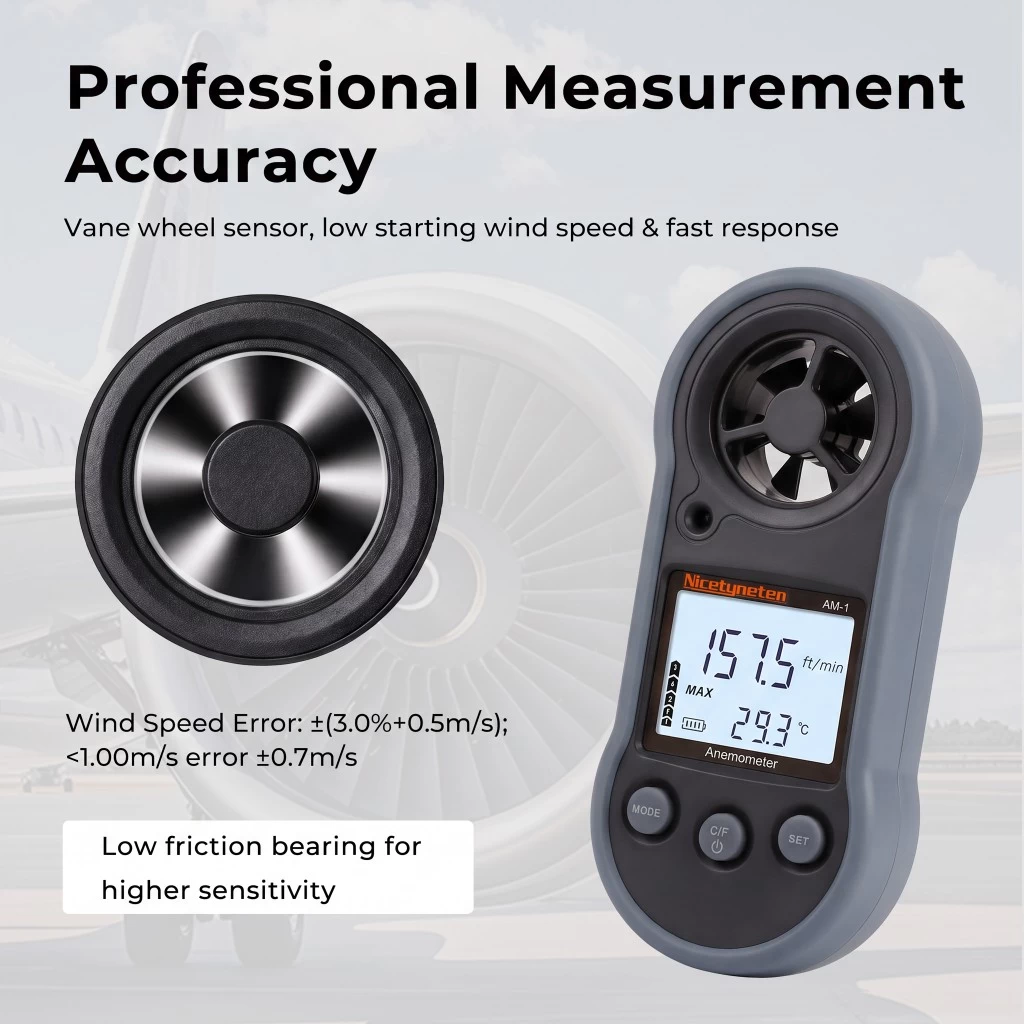
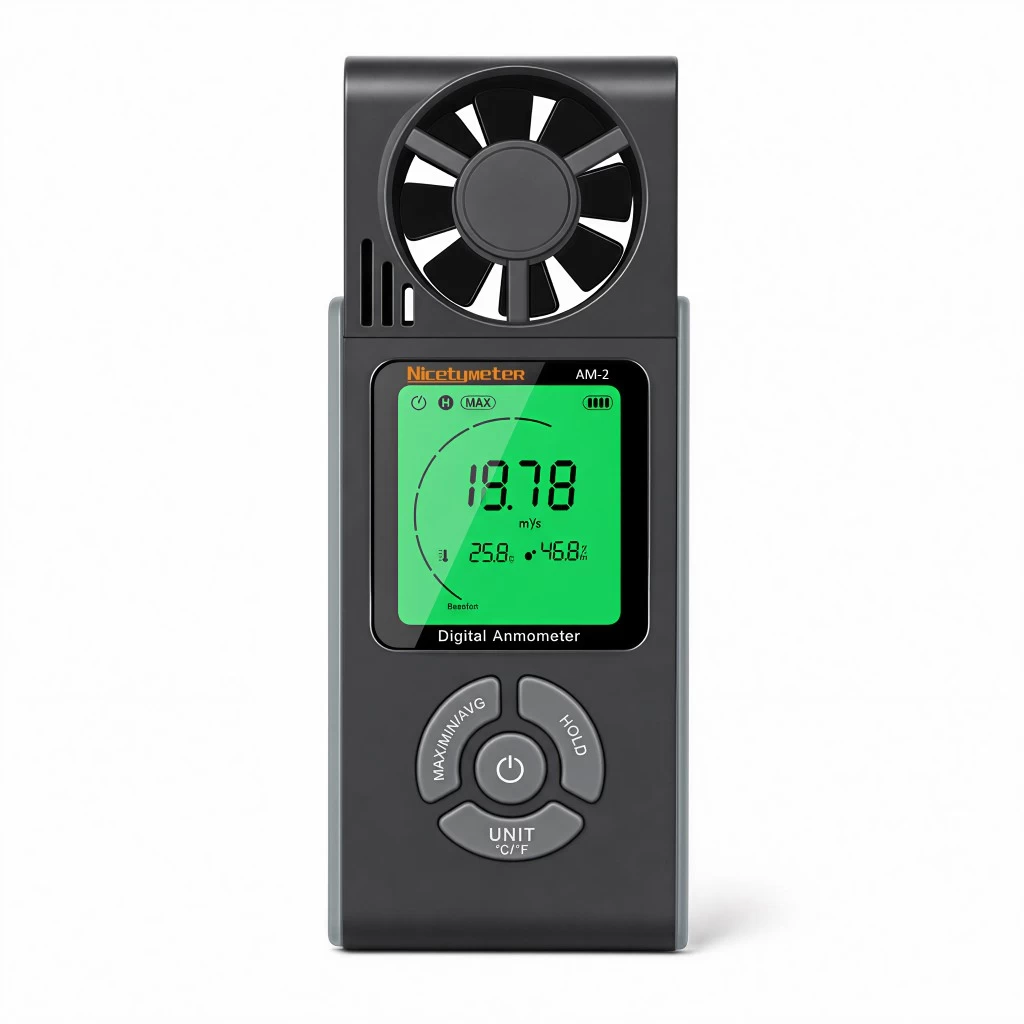
The AM-1 and the AM-2 share the same wind speed range — 0.7 to 30 m/s, both on bearing-mounted impellers, both CE and RoHS. So range is not the question. What separates them is what happens after the impeller starts turning: the AM-1 reads to 0.1 m/s, the AM-2 to 0.01, and their accuracy is specified differently across the band. Then there is the part no spec sheet shows — one of them you can drop in the water, the other tells you the humidity.
Resolution is the real divider
Both meters will register a 0.8 m/s draught, so "can it read low speeds" is the wrong question. The question is whether it can tell 0.84 from 0.88. On a damper that needs a quarter turn, or a diffuser you are trying to bring from 1.64 to 1.70, the AM-1 steps through 1.6, 1.7 and 1.8 while the AM-2 shows you the drift in between.
The accuracy figures diverge the same way. The AM-1 holds a flat ±5% across its whole range. The AM-2 quotes ±0.7 m/s below 1 m/s and ±(3.0%+0.5 m/s) from 1 to 30 — a tighter band where most balancing work actually happens.
| AM-1 | AM-2 | |
|---|---|---|
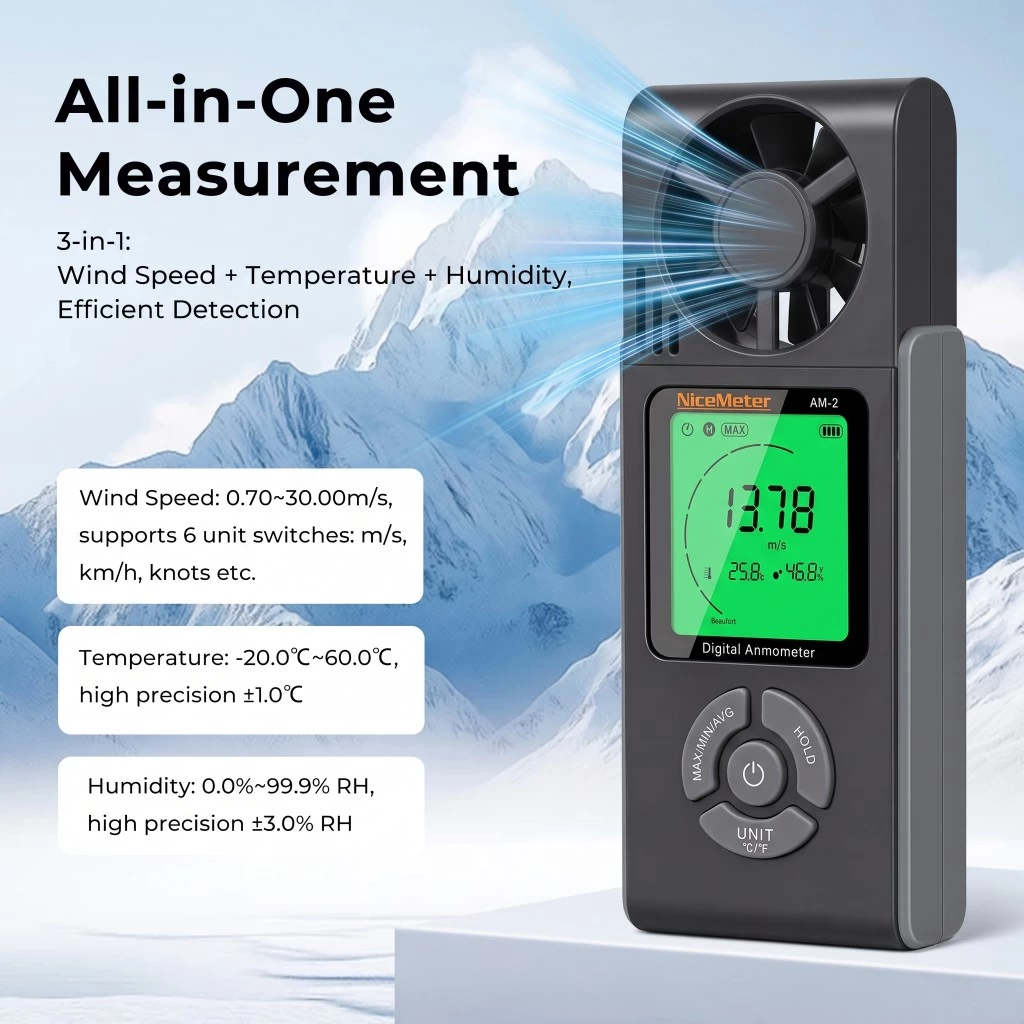
| Wind speed | 0.7–30 m/s 0.1 resolution, ±5% | 0.70–30.00 m/s 0.01 resolution, ±0.7 m/s below 1 m/s; ±(3.0%+0.5 m/s) above |
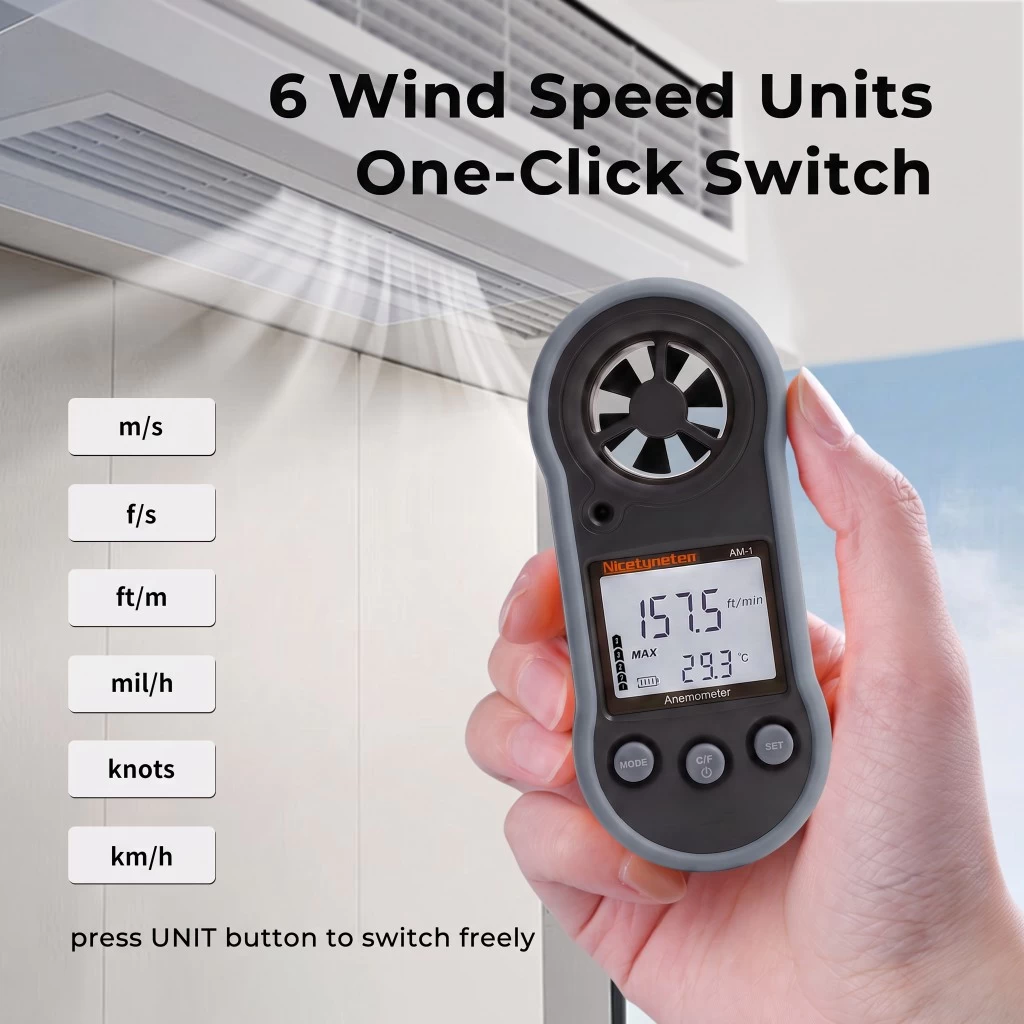
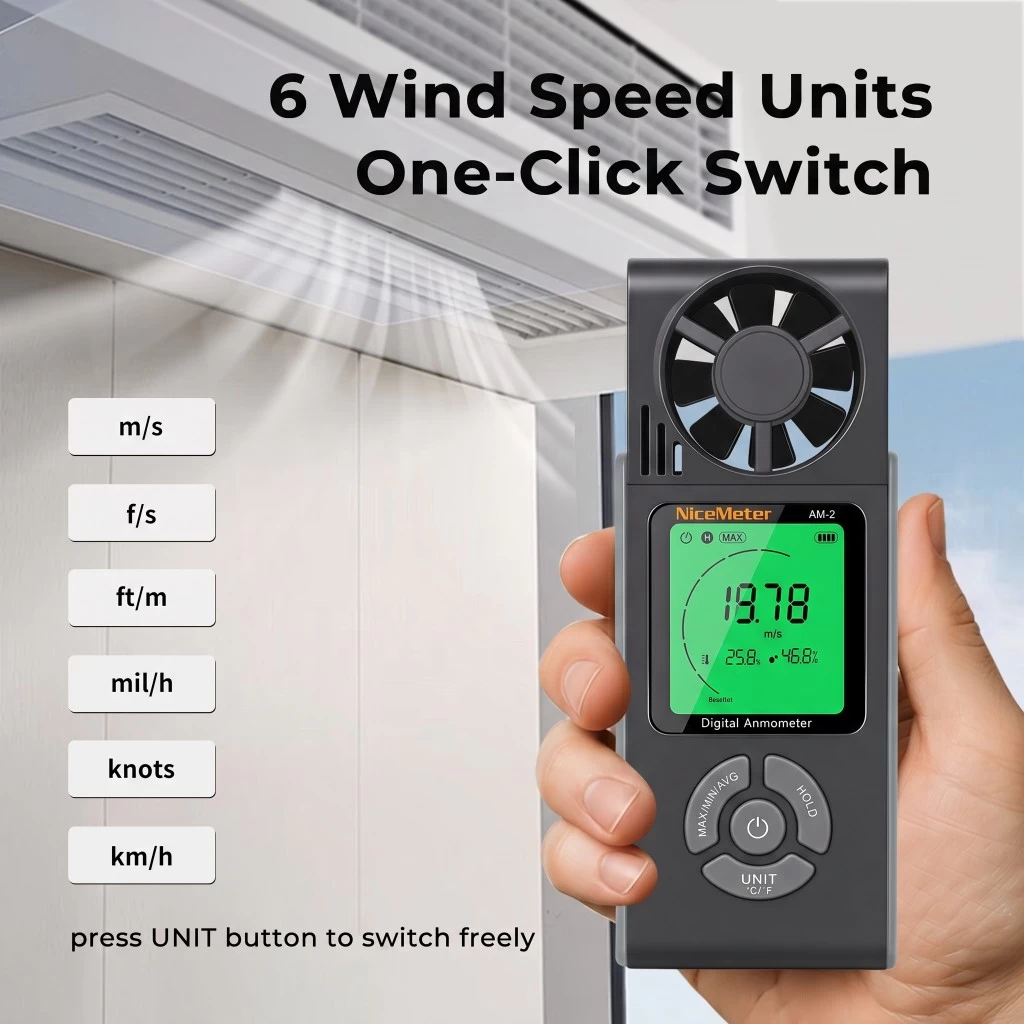
| Units | 5 (m/s, km/h, ft/min, knots, mph) | 6 (adds ft/s) |
| Climate | 0 to +45 °C air temp, ±2 °C | −20 to 60 °C, ±1 °C; 0–99.9% RH, ±3% |
| Body | 80 × 110 mm, 72 g with battery | 149 mm long, 107 g net / 143 g with cells |
| Power | CR2032, ~1 year | 3 × AAA, ~200 hours |
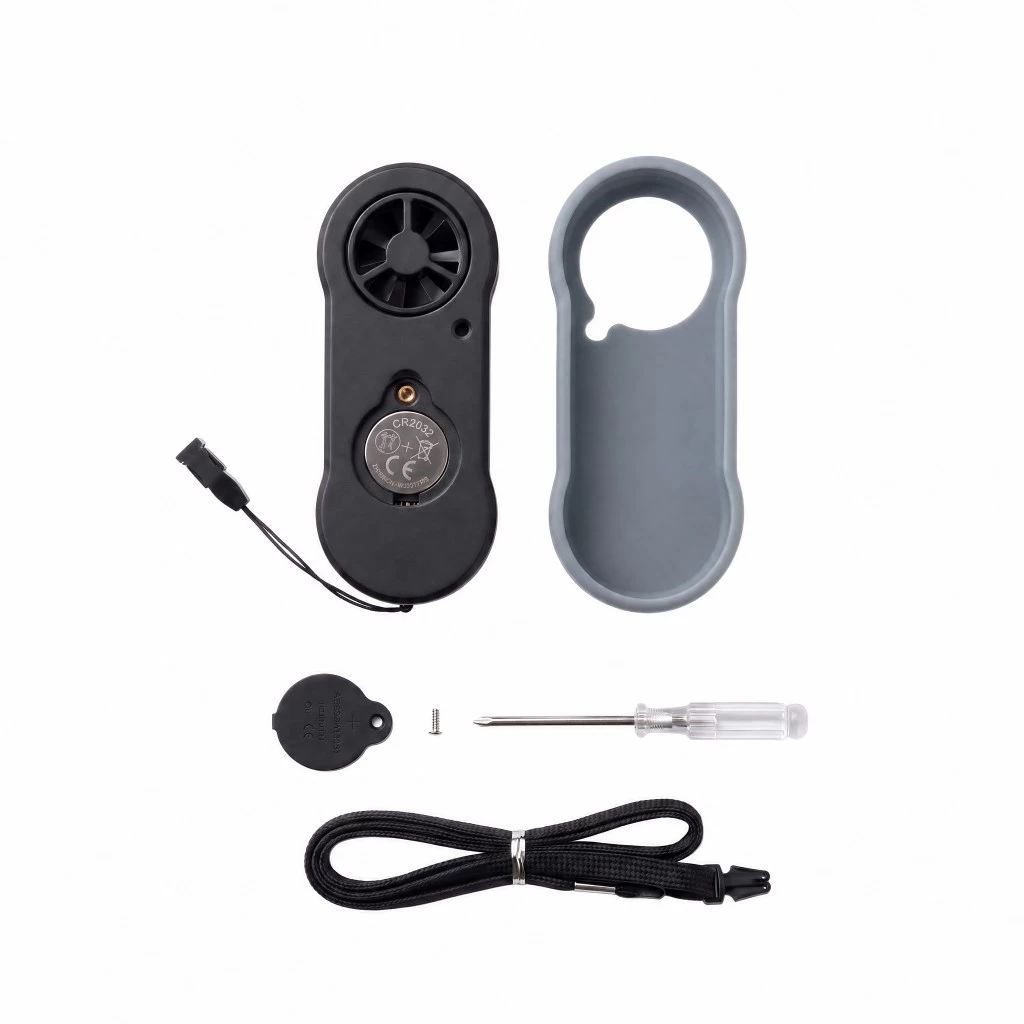
| Carry | Detachable silicone cover + wrist strap | Fixed housing |
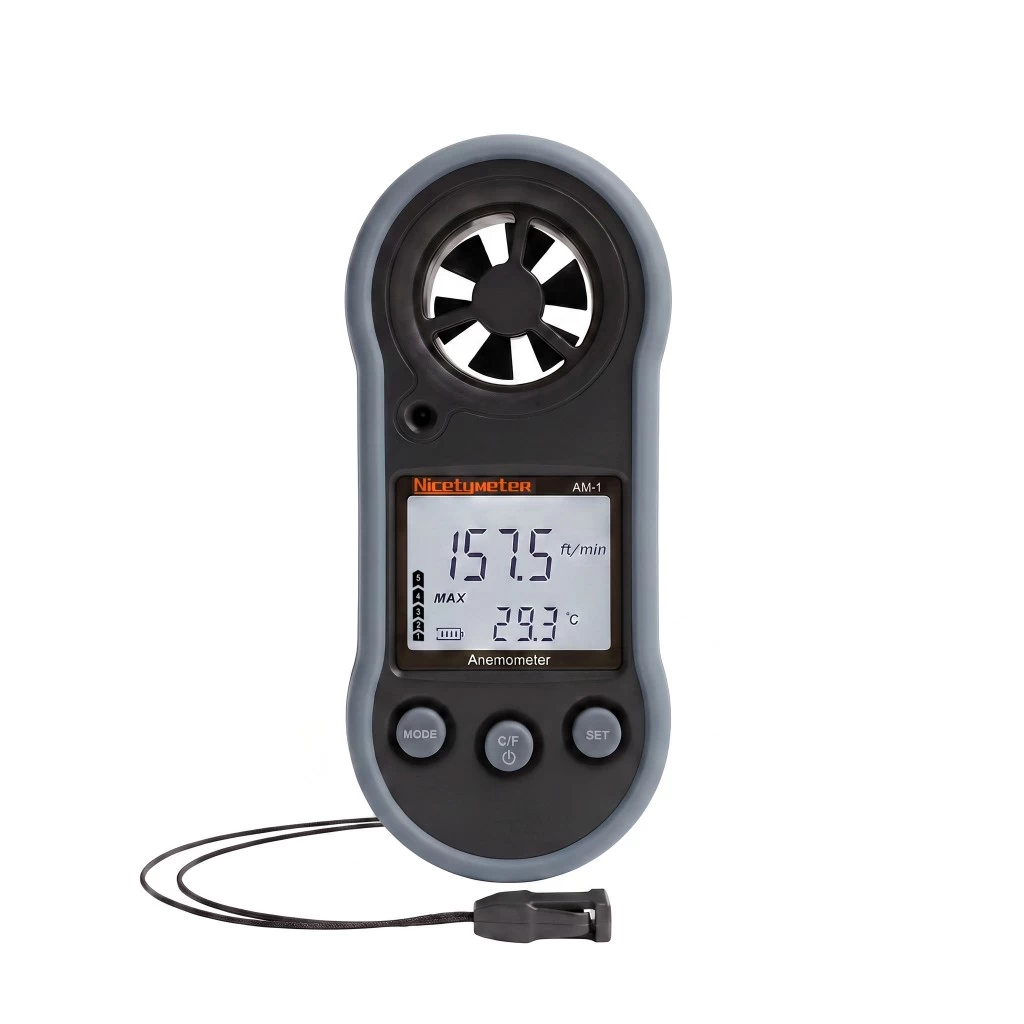
AM-1: the one that lives in a jacket pocket
72 g with the battery in, one CR2032 for about a year at ten minutes a day — you stop thinking about power entirely. Five units plus Beaufort 0–12 on the same screen means you can say "force 5" out loud without converting anything in your head.
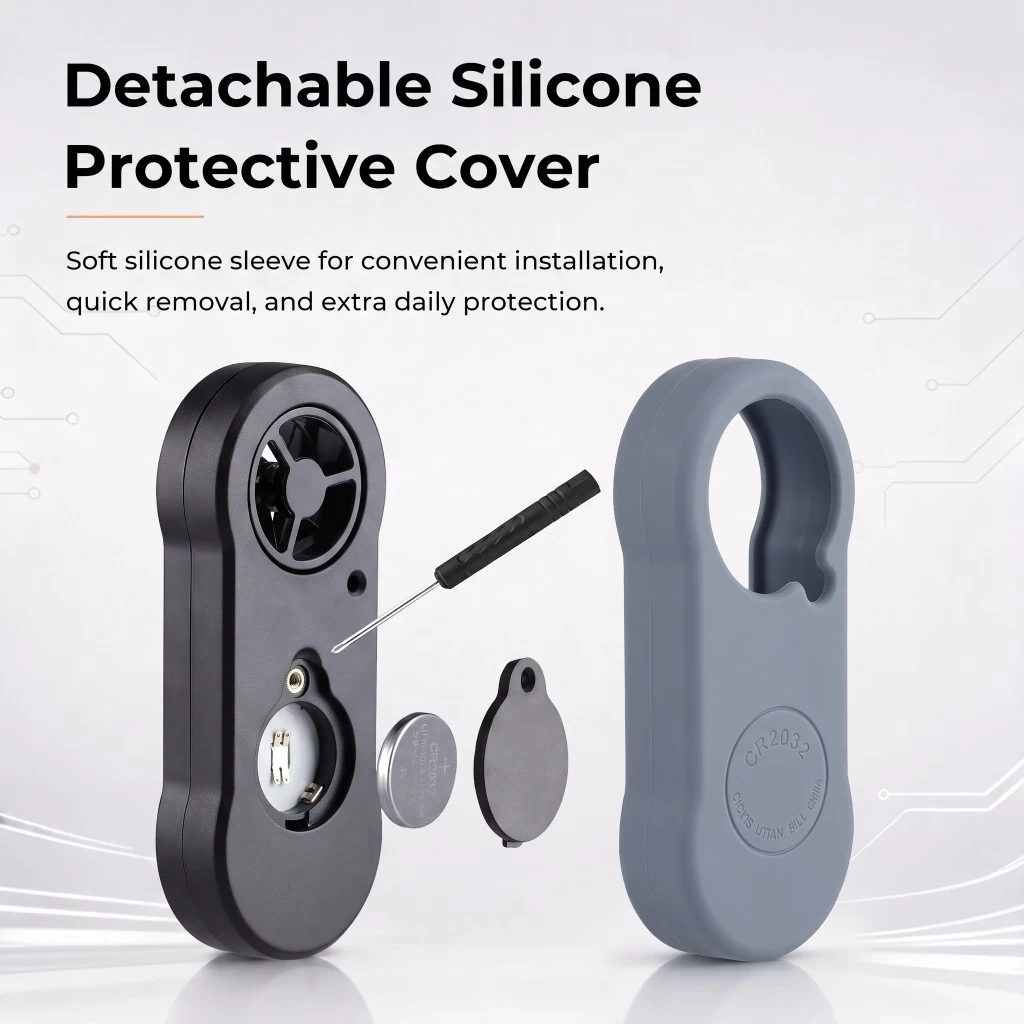
The silicone cover is the real feature
Spec sheets skip it, but the detachable sleeve is why this meter survives being used. It absorbs the drop from a kayak deck onto rock. It gives you something to grip with wet, cold hands. It peels off in one motion so you can rinse the salt and sand out from underneath instead of letting it grind against the case for a season. The wrist strap is not decoration either — over water, a lanyard is the difference between a reading and a lost instrument.
Wind chill, on the water and on the ice
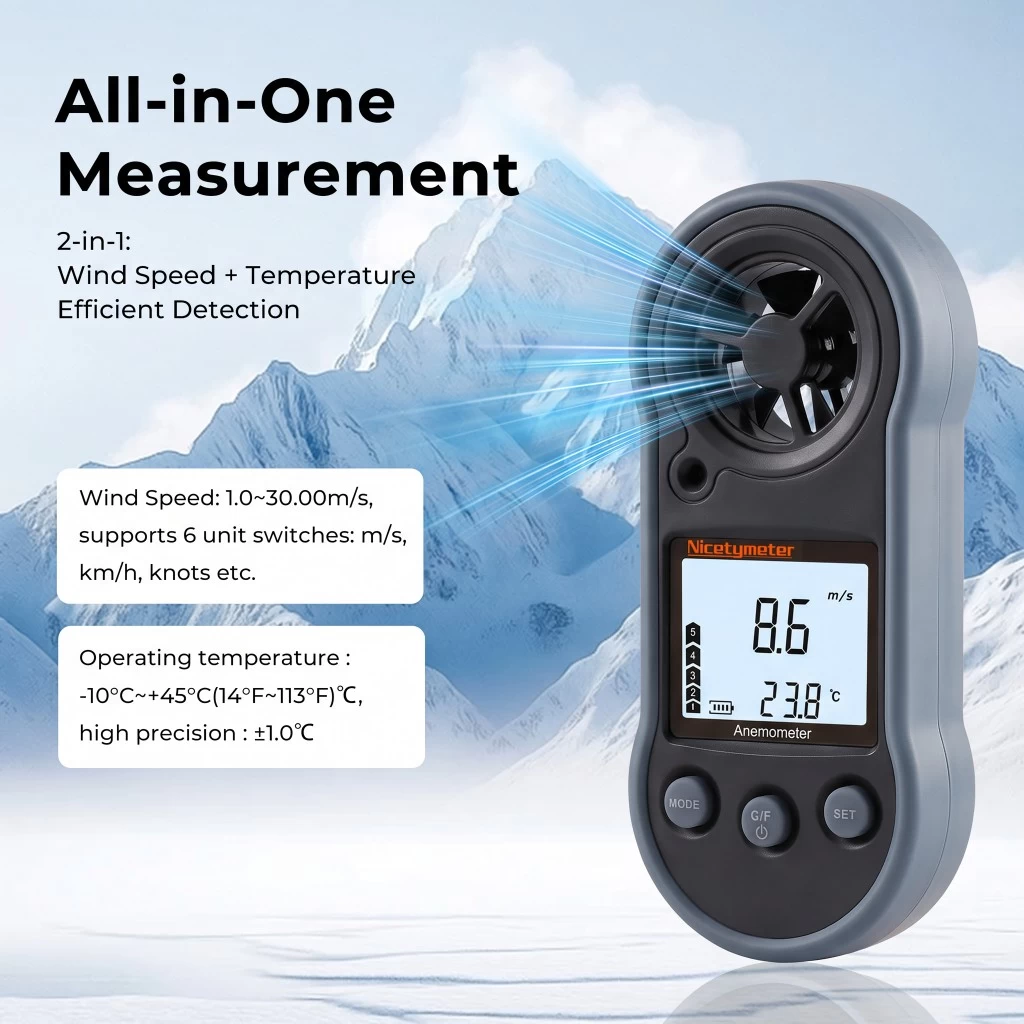
Speed, air temperature and wind chill on one screen answer the question anglers and sailors actually ask: not "how fast is the wind" but "how long can I stay out". A 9 °C morning at 3 m/s feels like 9 °C. The same morning at 12 m/s feels like 3 °C, and that changes what you wear and when you head in.
Where the 0.1 step starts to hurt
Outdoors it never does — a wind that swings four metres a second while you watch has no use for a hundredth. It only bites when you are trying to prove something small: that a damper change moved the airflow by 0.06 m/s, or that two grilles 40 cm apart are actually different. In that situation the AM-1 will show the same number twice and you will not know whether nothing happened or the meter simply cannot see it. The air-temperature spec also starts at 0 °C, so a hard winter morning sits outside it even though the wind reading still works.
Pick the AM-1 if the wind you measure is outdoors and moves enough to feel, the instrument will be dropped, splashed and carried in a pocket, and you would rather never think about batteries.
AM-2: the one built for the plant floor
Longer body, larger impeller assembly — and a bigger impeller catches more of a slow airstream, which is why the low end of this meter feels steady rather than merely readable. Together with the bearing it turns on, it holds a clean reading at 0.8 m/s where a smaller rotor is already hunting.
0.01 resolution, and what it buys
Below 1.00 m/s the tolerance is ±0.7 m/s, a fixed offset that is normal for any impeller at the bottom of its scale. From 1.00 to 30.00 m/s it tightens to ±(3.0%+0.5 m/s). The resolution earns its place in the middle of that band: you can watch a 0.04 m/s drift when you nudge a damper, instead of watching the last digit sit still and guessing.
Tri-colour backlight, HOLD, and the rest
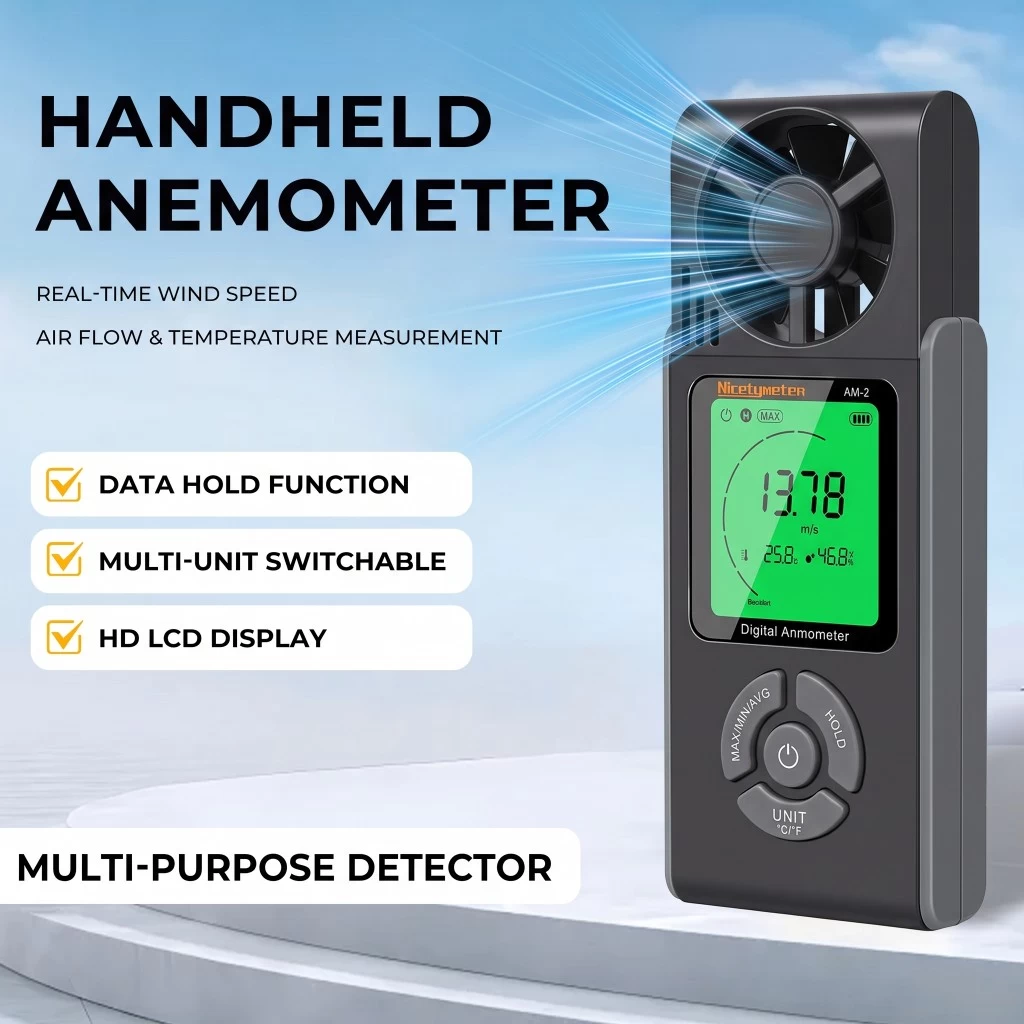
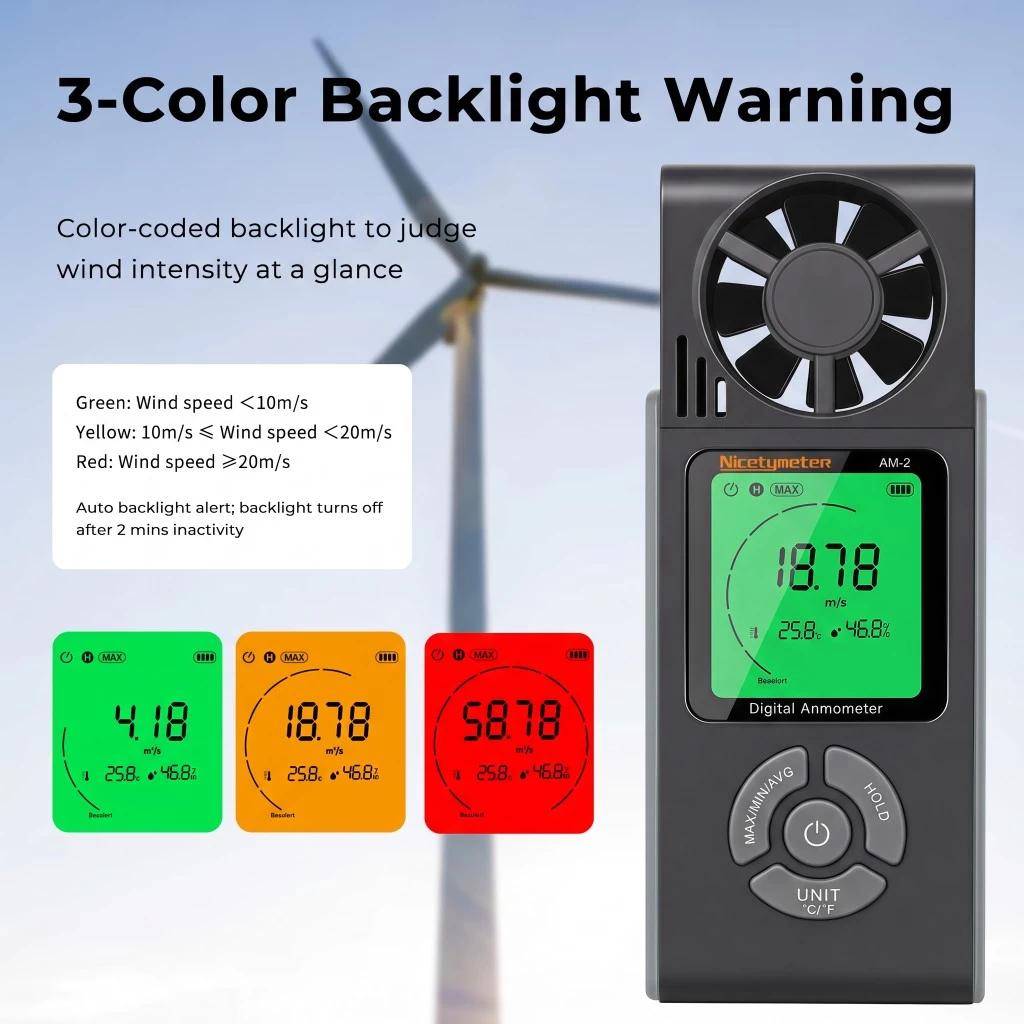
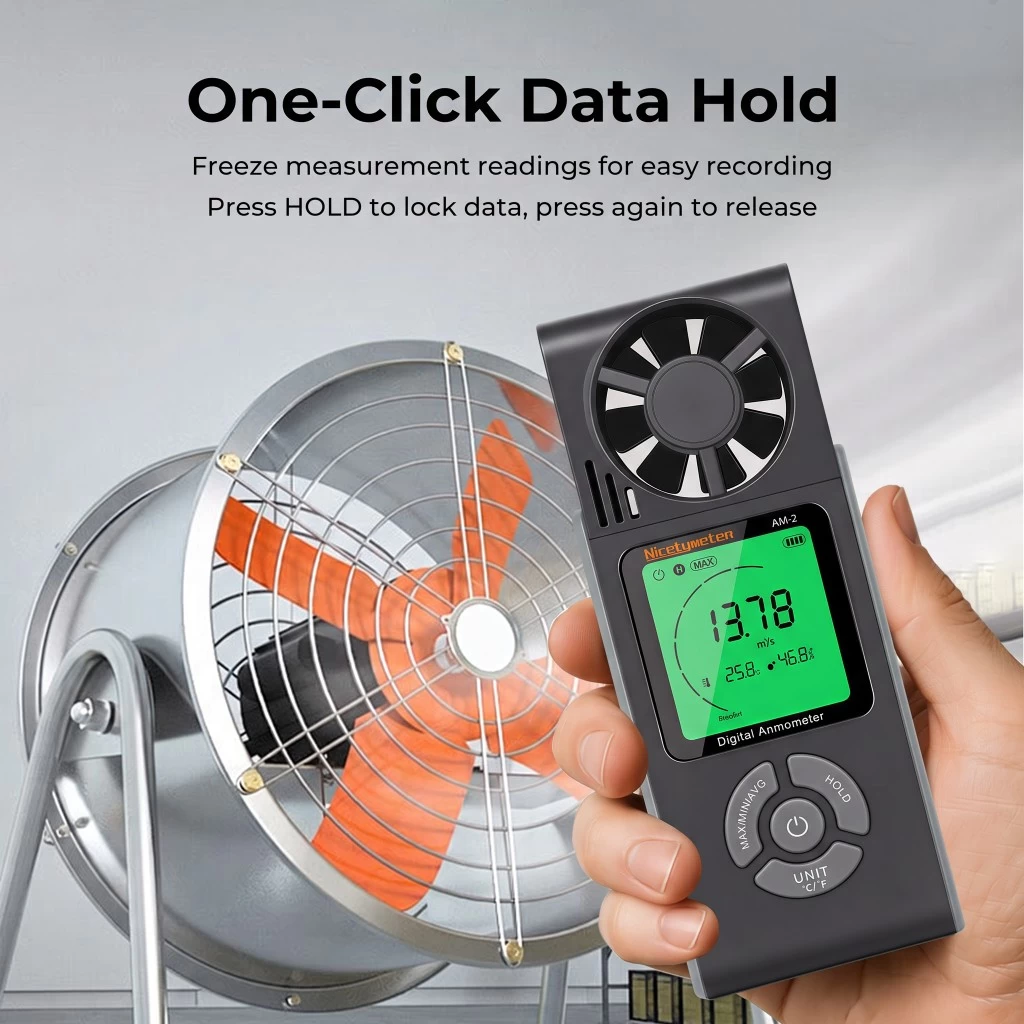
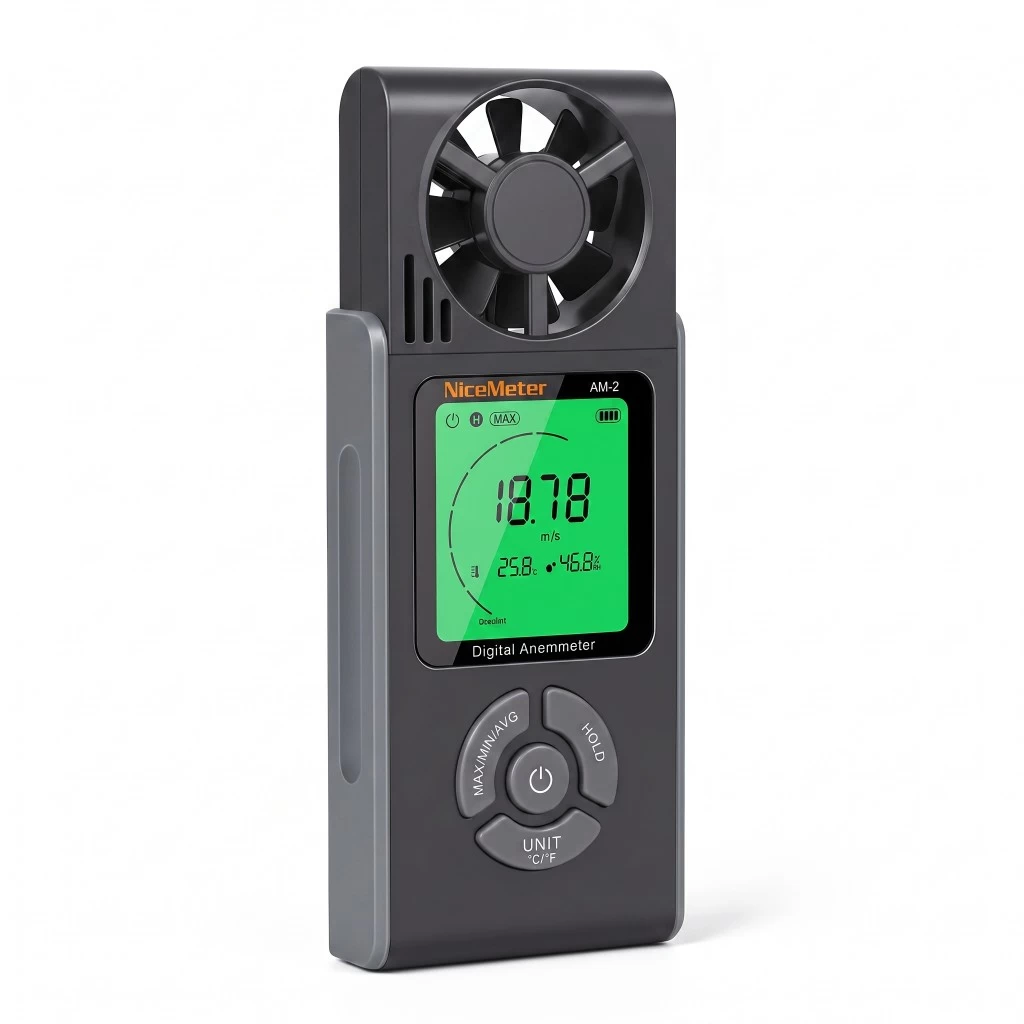
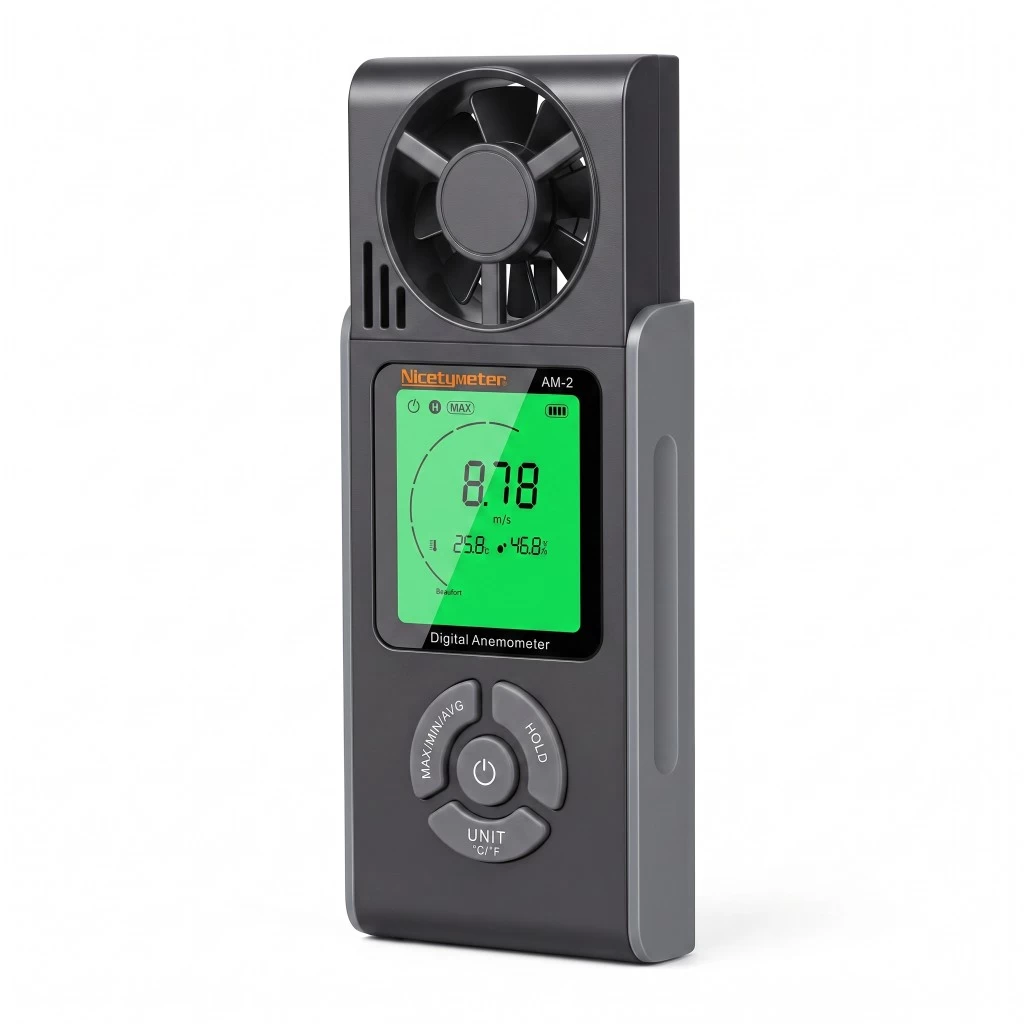
Green below 10 m/s, yellow 10–20, red at 20 and above — on a ladder that is faster to read than a number. HOLD freezes a reading so you can climb down and write it up without wondering whether it was 1.64 or 1.84, and MIN/MAX/AVG cover the three questions a commissioning sheet usually asks. Temperature runs −20 to 60 °C at ±1 °C, humidity 0–99.9% RH at ±3%, so greenhouse, cold store and drying-room checks come out of one visit instead of three. Three AAA cells give about 200 hours.
Pick the AM-2 if airflow is the work itself — you need 0.01 resolution and tighter accuracy, want temperature and RH in the same reading, or compare many points in a day.
Matching the meter to the job
| Scenario | What matters | Model |
|---|---|---|
| Shore and boat fishing | Wind chill, Beaufort, grip with wet hands, wrist strap | AM-1 |
| Surfing, kitesurfing, sailing | Pocket size, splash and drop resistance, one glance reading | AM-1 |
| Hiking, cycling, drone flying | 72 g, coin cell, nothing to charge | AM-1 |
| HVAC balancing, diffuser and grille checks | 0.01 resolution, ±(3%+0.5) accuracy, HOLD | AM-2 |
| Industrial ventilation, fume hoods, road tunnels | Tight tolerance, MIN/MAX/AVG, tri-colour alert | AM-2 |
| Greenhouse, cold store, drying room | Humidity and temperature in the same pass | AM-2 |
| Wind siting, ports and yards | Range to 30 m/s plus recorded averages | AM-2 |
The habits that matter more than the meter
Most bad wind readings are technique problems, not instrument problems.
- Hold the impeller on the airflow axis. Read 30° off-axis and you under-read. Point it into the stream, not at the grille face from the side.
- Keep 5–10 cm from the outlet. Too close and you measure the jet core, not the delivered airflow. Too far and you measure the room.
- Expect drift in still air. ±0.5 m/s with no airflow is normal — convection off your body and warm equipment is real air. Do not chase it as a fault.
- Average, do not snapshot. Turbulent air swings by the second. Use AVG over 10–20 seconds, or take three readings and drop the outlier.
Clean the impeller with a soft brush or dry swab, never water or solvent. The bearing is what gives you the low-speed sensitivity, and it is the part you are protecting.
So which one
For one meter covering outdoor life — fishing, surfing, hiking, the occasional vent check — the AM-1 at 72 g with its silicone cover is what will still be in your bag in three years. If airflow is the work itself, and you need to see a 0.06 m/s change, compare six points before lunch and hand over a humidity number too, the AM-2 earns its extra size on the first commissioning job.
Carrying both is not unreasonable. Plenty of field technicians keep the AM-1 outdoors and the AM-2 in the van for anything that has to be written down.
FAQ
Can the AM-1 measure an air conditioner outlet?
Yes. Hold the impeller 5–10 cm in front of the outlet and use MAX mode to catch the peak. What it will not do is resolve small differences between outlets — at 0.1 m/s steps, two vents delivering 1.64 and 1.70 m/s look identical.
If both start at 0.7 m/s, why does the AM-2 cost more?
Resolution and accuracy, not range. The AM-2 resolves 0.01 m/s against the AM-1's 0.1, holds ±(3.0%+0.5 m/s) above 1 m/s against a flat ±5%, adds humidity, and adds HOLD with MIN/MAX/AVG recording.
Why does my anemometer show 0.5 m/s in a closed room?
The air is not still. Convection from your body, warm equipment and sunlight keeps a room moving at a few tenths of a metre per second, and every impeller anemometer shows it. Judge the zero by whether it repeats in the same place, not by whether it reaches 0.00.
Do I need to calibrate either meter?
For outdoor and general HVAC work, no — both meet their stated tolerance from the factory. For regulated compliance reporting, ask your supplier for a calibration certificate and a re-check interval. If a low-speed reading drifts far outside ±0.7 m/s in still air, suspect the impeller bearing before the electronics.